


Key Insights
- The agricultural sector saw the most business closures during the war in Ukraine, with 1261 companies dissolved from 2022 through the first quarter of 2024. The next largest sectors by number of closures are wholesale trade, real estate and construction companies.
- The proportion of legal service firms among all closed businesses doubled during the war. In 2021, legal firms constituted 2.3% of all business closures in Ukraine, but this share increased to 4.7% during the full-scale war period.
- Over the two years of the war, the intensity of company dissolutions decreased in the water supply, woodworking, retail and wholesale trade sectors.
- The intensity of official company dissolutions during the full-scale war increased the most in Odeska, Zaporizka, and Kyivska Oblasts compared to 2021.
- At the same time, a significant decrease in business closures was observed in Khersonska, Kharkivska, and Donetska Oblasts, primarily due to occupation rather than improved business conditions.
YC.Market data specifies that just over 4,000 companies closed in Ukraine in 2023, which is half the number of firms dissolved in 2021 before the full-scale invasion.
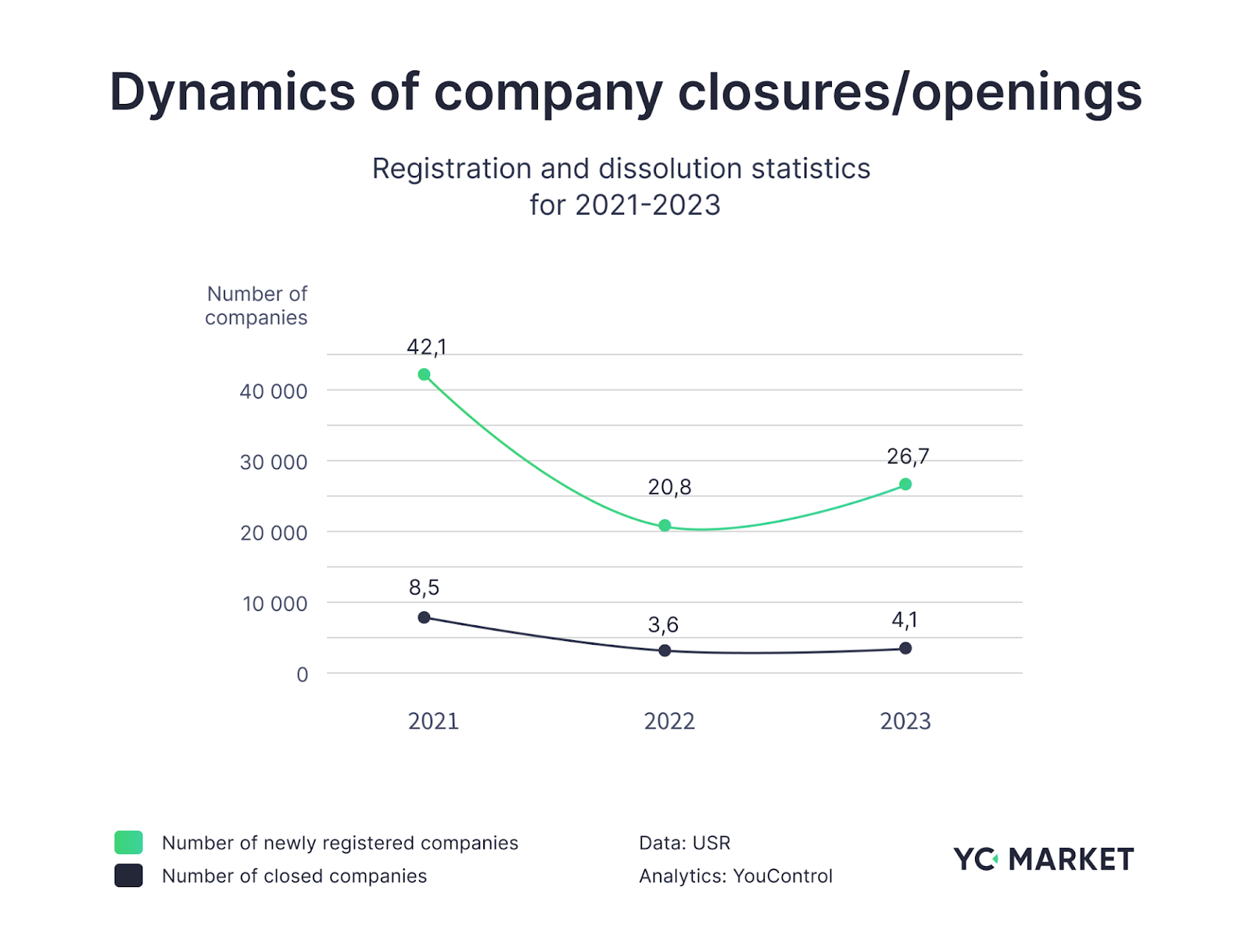
Quantitative indicators alone are insufficient for assessing the market situation. For instance, in 2021, the number of newly established companies was almost twice that in 2023. Therefore, based on an analysis of sectors and regions where company closures intensified during the full-scale war, YouControl.Market’s financial analyst Roman Kornyliuk calculated the dynamics of each sector’s share in the total number of officially dissolved companies.
Which industries suffered the most during the war?
The legal services market saw the highest increase in company closures during the full-scale invasion, with a sectoral share increase of 2.4 percentage points. This indicates that the closure rate of legal firms doubled during the war. “In 2021, among 100 randomly selected bankrupt Ukrainian companies, only 2.3 were legal firms. During the full-scale war, the legal sector’s share of all dissolved businesses rose to 4.7%,” explains Roman Kornyliuk, “This trend may reflect increased concentration in this fragmented industry, with larger law firms more likely to survive wartime conditions.”
Agriculture was the second most affected sector, with its share in company dissolutions rising by 1.4 percentage points. Other sectors with negative dynamics included real estate, medical institutions, and financial services.
Companies in the water supply, woodworking, retail and wholesale trade, and construction sectors have seen a decline in dissolutions over the two years of war.
“The reasons for the reduced share of closures in these industries lie in their sectoral specifics. Water supply, construction, and large retail networks are critical infrastructures whose functioning becomes even more essential during wartime,” notes financial analyst Roman Kornyliuk. “Additionally, the construction sector’s role in reconstruction and rebuilding cannot be underestimated. Monetary support for price and financial stability, alongside the accumulation of funds in current accounts, has boosted the turnover of wholesale and retail trade. These factors collectively contributed to fewer bankruptcies in these economic sectors.”.
Which regions experienced the most company closures during the war?
In 2023, Kyiv, Odeska, Dnipropetrovska, Lvivska, and Kyivska Oblasts recorded the highest number of company closures.
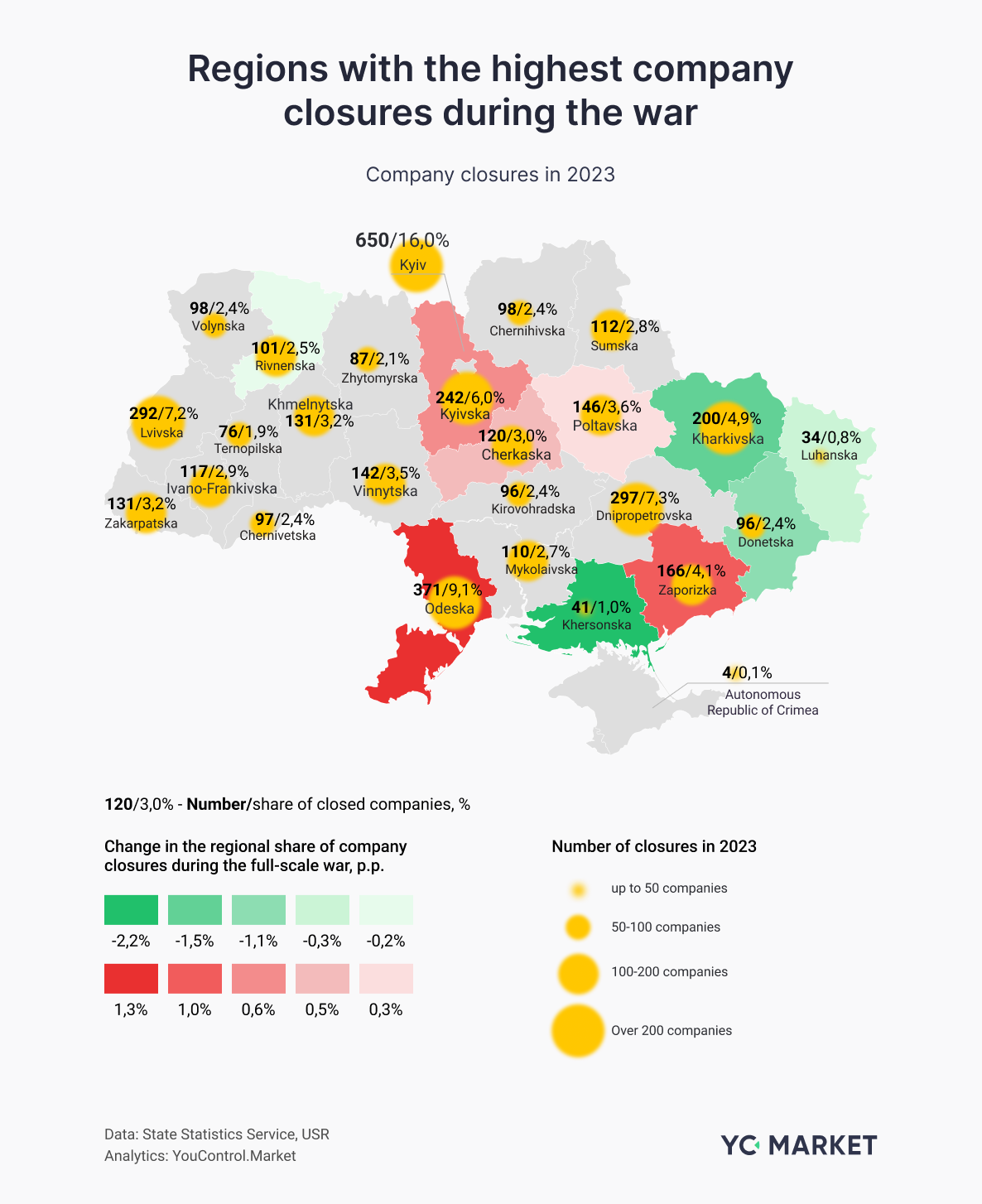
Analysing the dynamics of company closures during the war, Odeska, Zaporizka, and Kyivska Oblasts saw the most significant increase in closure intensity. The share of total closures in Odeska Oblast during the full-scale war increased by 1.6 percentage points, from 7.4% to 9%, indicating deteriorating business conditions. Additionally, company relocations from eastern regions to Odesa, a relocation leader, may have influenced closure rates as not all relocated companies managed to continue operations.
In Zaporizka Oblast, the share of closures rose by 1 percentage point, in Kyivska by 0.6 percentage points, in Cherkaska by 0.5 percentage points, and in Poltava by 0.3 percentage points.
Roman Kornyliuk, financial analyst at YouControl, explains:
“Comparing the growth rates of regional shares in official company closures during the full-scale war to 2021, Odeska, Zaporizka, and Kyivska Oblasts led the increase. The rise in these regions’ shares of business dissolutions was influenced not only by deteriorating business climates due to hostilities but also by the tendency of financially weakened companies to relocate from neighbouring occupied areas to Ukraine-controlled territories in these regions.
Conversely, Khersonska, Kharkivska, and Donetska Oblasts saw a significant decrease in their share of total closures. Unfortunately, this trend is linked to the occupation of parts of these regions, not improved business conditions. As fewer businesses remain within the legal framework of an occupied region, the proportional number of bankruptcies and business closures decreases compared to pre-occupation periods.”
Some figures for 2023 and early 2024
In 2023, agricultural companies experienced the highest closure rates, with 605 closures accounting for a record 14.9% of all closures during this period. This trend intensified in the first quarter of 2024, with agricultural company closures rising to 18% of all firm closures in Ukraine.
In the wholesale trade sector, 440 companies closed, while 340 companies in real estate operations and 260 construction firms also shut down in 2023. The legal sector saw 224 company closures in 2023, an increase from 197 in the pre-war year of 2021. This negative trend continued in the first quarter of 2024, with 104 legal companies closing. The share of closed legal companies grew from 2.3% in 2021 to 9.8% in the first quarter of 2024.
Kyiv led in the number of company closures in 2023, with 650 businesses closing. Odeska Oblast followed with 371 closures, Dnipropetrovska Oblast with 297, and Lvivska Oblast with 292 closures. The absolute number of closures closely correlates with the total number of operating enterprises and the region’s economic development level, making dynamic change indicators more informative.
How we calculated
The analysis covers the period of the full-scale war, considering data from 2022, 2023, and the first quarter of 2024.
The share of company closures is the ratio of closed companies in a region or sector to the total number of closed companies in Ukraine during the selected period, expressed as a percentage (%).
The change in the share of company closures is the difference between the share of closures during the war period and the share in 2021, expressed in percentage points (p.p.).
To improve the quality of the study, YouControl analysts have previously cleaned the full official financial reporting data set from legal entities with non-commercial legal forms.
To enhance the research quality, YouControl analysts pre-cleaned the complete official dataset of financial statements by excluding non-commercial legal entities. The study did not account for actual bankruptcies not reflected in the Unified State Register (USR), particularly companies not officially in the liquidation process and those registered in temporarily occupied territories or active combat zones.


